In brief
The short answer
Two decisions often get mixed up. The first is the assistant your teams use every day, billed per user. The second is the model your applications call through an API, billed per token. Prices, data settings and hosting options differ between the two, so this article treats them separately. For a wider view of assistants, see our comparison of AI chatbots for business.
Team assistants
Business plans and their prices
| Plan | Price per user | Billing | Minimum |
|---|---|---|---|
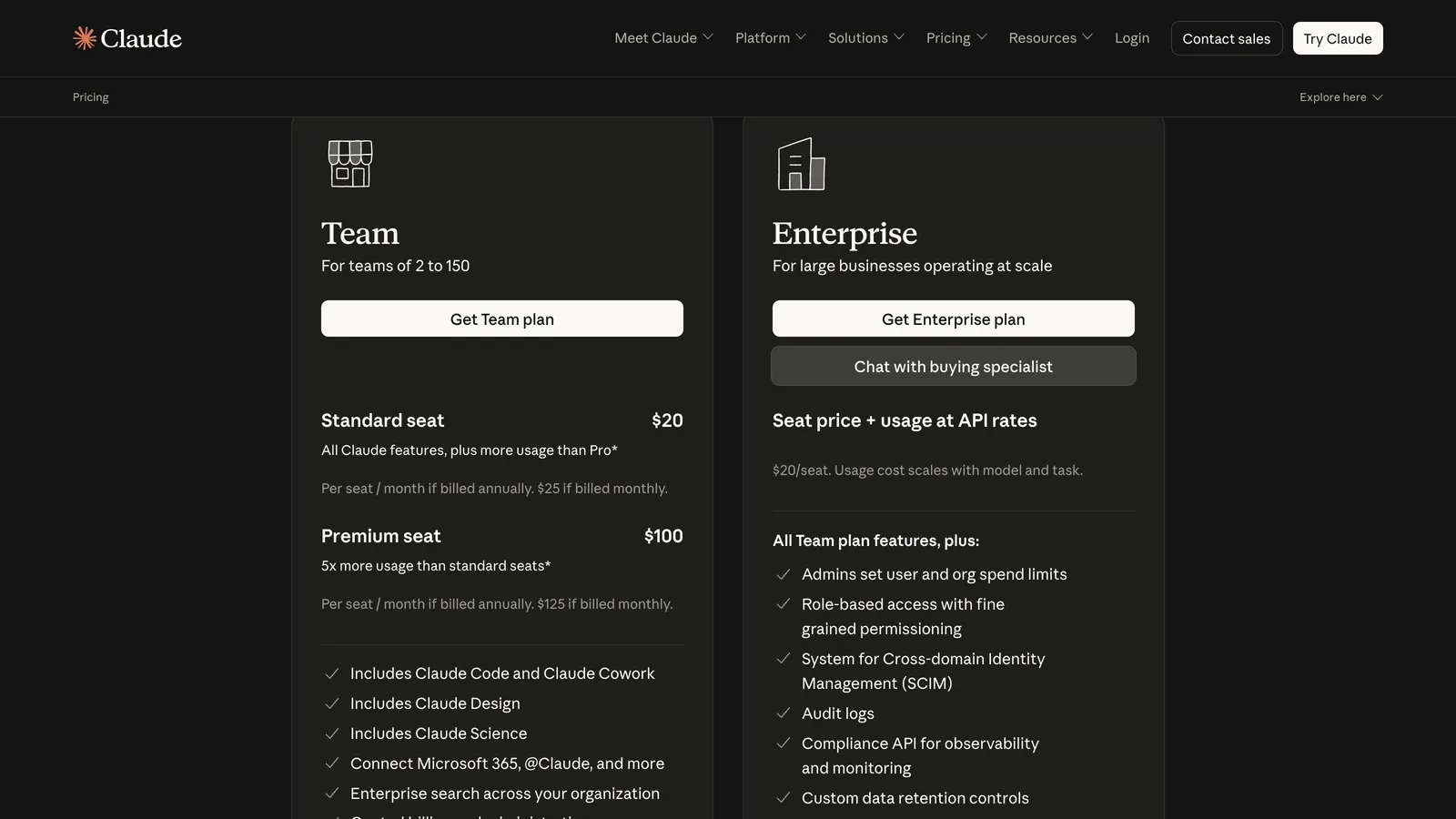
| Claude Team, Standard seat | $20/month billed annually, $25 monthly | Monthly or annual, in USD | 2 users, 150 maximum |
| Claude Team, Premium seat | $100/month billed annually, $125 monthly (5x Standard usage) | Monthly or annual | 2 users, 150 maximum |
| Claude Enterprise | $20 per seat, plus usage at API rates | Annual | Not published |
| ChatGPT Business Standard (per OpenAI's help centre) | $20/month billed annually, $25 monthly | Monthly or annual | 2 users |
| ChatGPT Business Premium (per OpenAI's help centre) | $100/month billed annually, $125 monthly | Monthly or annual | 2 users (Standard and Premium can be mixed) |
| ChatGPT Enterprise | Not published | Quote | Not published |
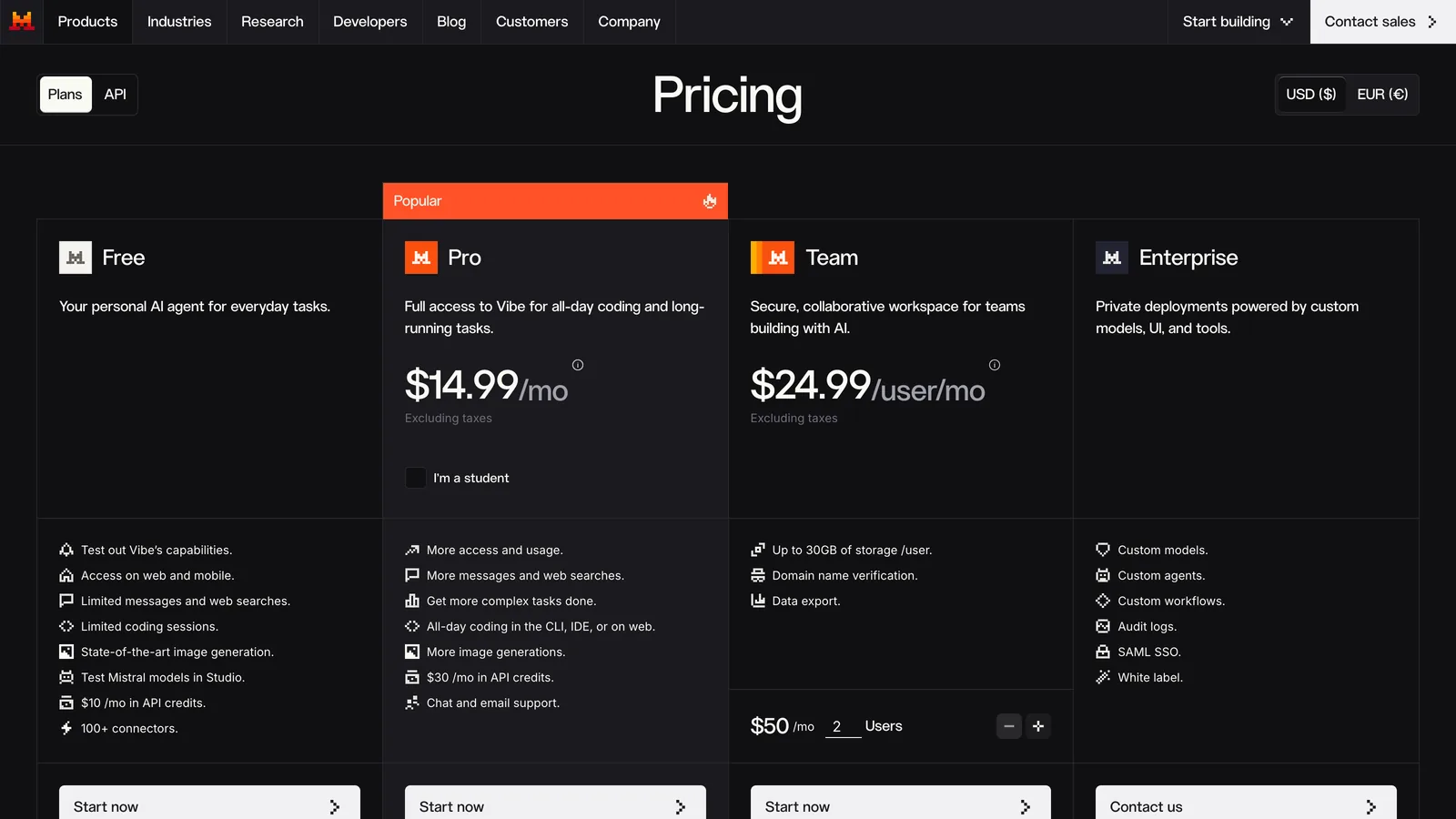
| Mistral Vibe Pro | $14.99/month excl. tax (€17.99 incl. tax in France) | Monthly | Not stated |
| Mistral Vibe Team | $24.99/month excl. tax (€29.99 incl. tax in France) | Monthly | $50 per month, i.e. 2 users |
| Mistral Vibe Enterprise | Quote | Quote | Not published |
Example for 10 users: Claude Team Standard or ChatGPT Business Standard billed annually come to $200 per month before any tax. Mistral Vibe Team comes to $249.90 per month excluding tax. On Mistral's page, the euro price shown for France includes tax while the dollar price excludes it, so compare on the same tax basis.
Claude Enterprise works differently: a $20 seat plus usage billed at API rates. The monthly cost therefore depends on the model chosen and how much each person uses it. Admins can set spend limits per user and per organisation.
For your applications
API models and prices
| Provider | Model | Input / output (per million tokens) | Context |
|---|---|---|---|
| Anthropic | Claude Fable 5.1 | $10 / $50 | 1 million |
| Anthropic | Claude Opus 5 | $5 / $25 | 1 million |
| Anthropic | Claude Sonnet 5 | $2 / $10 | 1 million |
| Anthropic | Claude Haiku 4.5 | $1 / $5 | 200,000 |
| OpenAI | GPT-6 Astra | $10 / $50 (cached input: $1) | 1.05 million |
| OpenAI | GPT-5.6 Sol | $4 / $20 | 1.05 million |
| OpenAI | GPT-5.6 Terra | $2 / $12 | 1.05 million |
| OpenAI | GPT-5.6 Luna | $0.20 / $1.20 | 1.05 million |
| Mistral | Mistral Medium 3.5 | $1.5 / $7.5 | 256,000 |
| Mistral | Mistral Large 3 | $0.5 / $1.5 | Not verified |
| Mistral | Mistral Small 4 | $0.15 / $0.6 | 256,000 |
Five points price comparisons tend to miss:
- Mistral Large 3 is cheaper than Medium 3.5 on the official page: $0.5 against $1.5 for input. Medium 3.5, released with open weights on 28 April 2026, is the newer one. The model name tells you nothing about its price.
- Claude Sonnet 5 pricing is now permanent. The $2 and $10 launch price was due to rise to $3 and $15 on 1 September 2026; Anthropic dropped that increase.
- Claude's tokenizer counts higher. Anthropic's documentation says Claude 4.7 and later models produce about 30% more tokens for the same text. A lower price per token does not guarantee a lower cost per document.
- Region options cost extra. At OpenAI, data residency endpoints cost 10% more for models released on or after 5 March 2026. At Anthropic, US-only inference is billed at 1.1 times the standard price.
- Discounts differ. Anthropic's Batch API is 50% cheaper. Mistral says cached input costs 90% less.
Worked example: 1,000 documents of 5,000 tokens each, with a 500-token answer, which makes 5 million input tokens and 0.5 million output tokens. Claude Sonnet 5: $15. GPT-5.6 Terra: $16. Mistral Medium 3.5: $11.25. Mistral Large 3: $3.25. Claude Haiku 4.5: $7.50. These figures assume the same token count at all three providers, which is never exactly true, so run a real sample. Anthropic costs are broken down in our guide to Claude API pricing for businesses.
GPT-6 Astra is OpenAI's flagship model on 15 September 2026; its early September release was reported by the press (CNBC, 3 September 2026). We quote no benchmark scores, because the ones in circulation come from secondary sources.
Data
Is your data used for training?
| Plan | Training by default | Source |
|---|---|---|
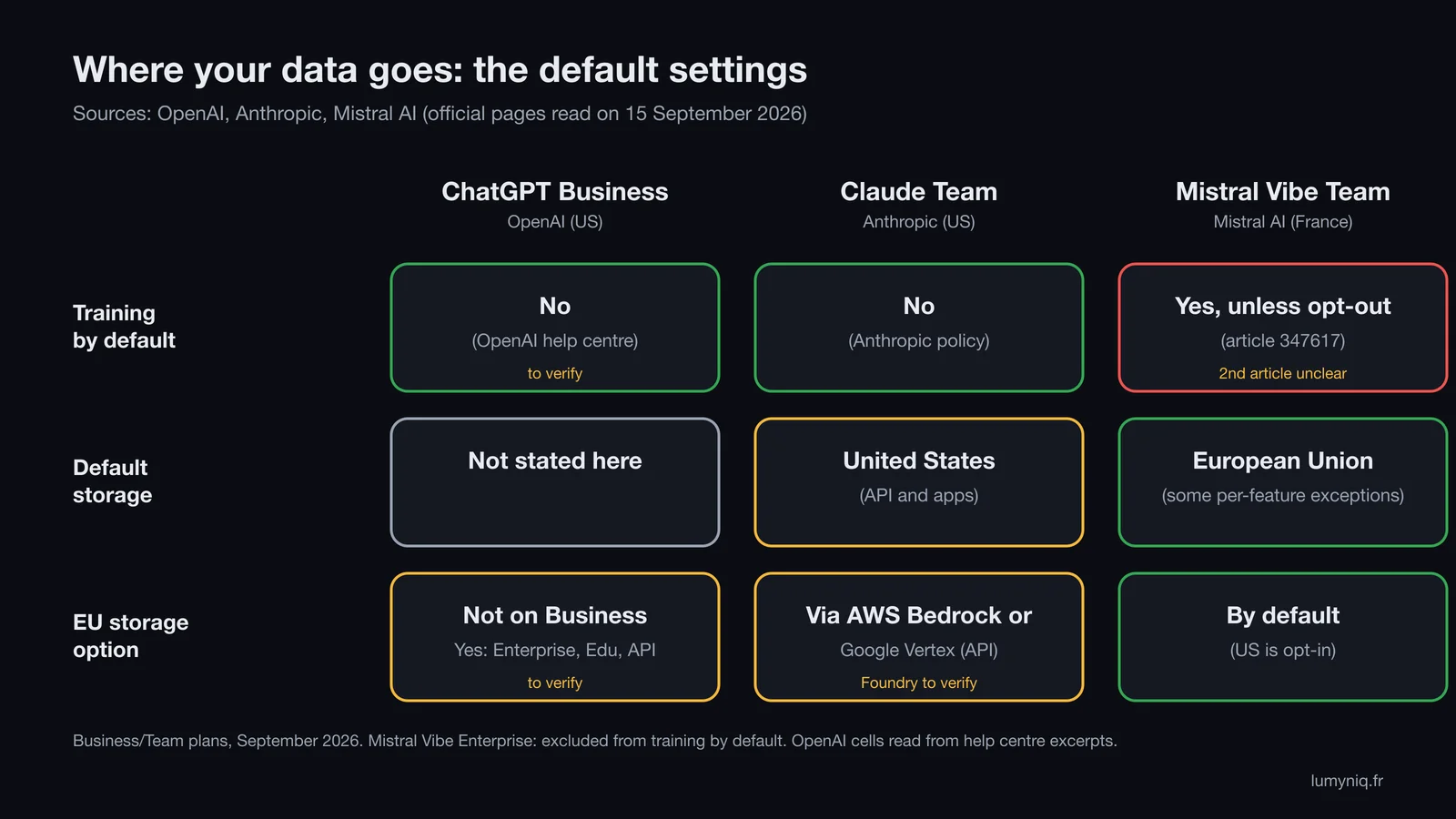
| Claude Team, Enterprise, API | No | Anthropic privacy centre (article 7996868) |
| ChatGPT Business, Enterprise, Edu, API | No | OpenAI enterprise privacy page (per OpenAI's help centre) |
| Mistral Vibe Free, Pro and Team | Yes, unless you opt out | Mistral help article 347617 |
| Mistral Vibe Enterprise | No (opted out by default) | Mistral help article 347617 |
This is the point comparison pages rarely pick up. Mistral Vibe Team, the team plan of the provider often presented as the sovereign choice, uses data to train models until the opt-out is switched on, according to Mistral help article 347617. Only the Enterprise plan is opted out by default.
A second Mistral article (455207) says Team admins can disable training, without stating the starting setting. The two texts do not necessarily contradict each other, but the second is less clear. Before any client document is sent, an admin should check the setting in the console and record it in your processing register.
Anthropic states that it does not use inputs or outputs from its commercial products to train its models by default. That setting says nothing about storage location, covered in the next section. For safeguards on the application side (access rights, logging, minimal data), see our guide to AI agent security.
Residency
Where data is stored
| Provider | Default storage | European option | Limits |
|---|---|---|---|
| OpenAI | Not stated for Business in our sources | European residency since 5 February 2025 for the API, Enterprise and Edu, new workspaces only | Not available on Business (per OpenAI's help centre) |
| Anthropic | United States for the API and Claude apps | Through AWS Bedrock or Google Vertex; Microsoft Foundry listed by Anthropic but unconfirmed | Inference "global" or "us" on the direct API; no EU option |
| Mistral | European Union | By default; a US endpoint is available as an option | Some features can temporarily transfer data outside the EU; Enterprise can switch them off |
OpenAI also offers data residency in the UK, the US, Canada, Japan, South Korea, Singapore, India, Australia and the UAE, plus in-region inference (EU or US) for eligible Enterprise, Edu and Healthcare customers, according to its help centre. A small business that buys ChatGPT Business to keep data in Europe has picked the wrong plan.
Anthropic has no European storage on its own platform. Its regional compliance page lists Europe as available on Bedrock, Vertex and Foundry, but InfoQ reported in July 2026 that Foundry did not yet have an EU data zone. For a project that requires European hosting, we use Bedrock or Vertex and select the region in the cloud provider's console. The same route applies to RAG over internal documents that fall under the GDPR.
Mistral says data is hosted in the European Union by default. Its subprocessor list, in the Trust Center, shows which features can temporarily move data out. Mistral Vibe Enterprise can also be deployed on premises, in a private cloud or on Mistral Cloud.
Legal
The CLOUD Act and the Data Privacy Framework, without shortcuts
What the law says. The CLOUD Act was enacted in March 2018 to speed up access to electronic information held by US-based global providers, according to the US Department of Justice. Its April 2019 white paper explains that a US provider must comply with valid US legal process (a warrant or court order) for data in its possession, custody or control, wherever the data is stored. The provider can ask for the order to be quashed or modified if it conflicts with foreign law.
Our analysis (this paragraph is our reading of the text): a data centre located in Europe but run by a US company remains within reach of US legal process, since the test the law applies is control of the data. OpenAI's European residency, or Claude through a European AWS or Google region, reduces transfers without taking the data outside the scope of that law. A French or European provider that is not controlled from the United States is not subject to it. Many pages claim one thing or the other without citing the text; the DOJ white paper is the source to read.
The Data Privacy Framework remains the legal basis for transfers of personal data to certified US companies. The European Commission adopted its adequacy decision on 10 July 2023. On 3 September 2025, the EU General Court dismissed Philippe Latombe's action (case T-553/23) and upheld the framework. An appeal to the Court of Justice, registered as C-703/25 P, was still pending as far as we could find on 15 September 2026.
The DPF governs transfers under the GDPR; it does not settle the CLOUD Act question. They are two separate points to document in your impact assessment. On the AI Act side, the Article 50 transparency obligations have applied since 2 August 2026 whatever the provider: see our AI Act guide for businesses.
Public sector
SecNumCloud and adoption by the French State
SecNumCloud is the qualification issued by ANSSI, the French cybersecurity agency, for trusted cloud services. According to public descriptions of the framework, version 3.2 includes requirements that protect against non-EU laws. The qualification covers a specific offer from a host; an AI model is not qualified as such.
- Mistral on Outscale. Mistral Embed and Mistral Medium are available on Outscale's SecNumCloud 3.2 marketplace (Outscale announcement, 14 October 2025).
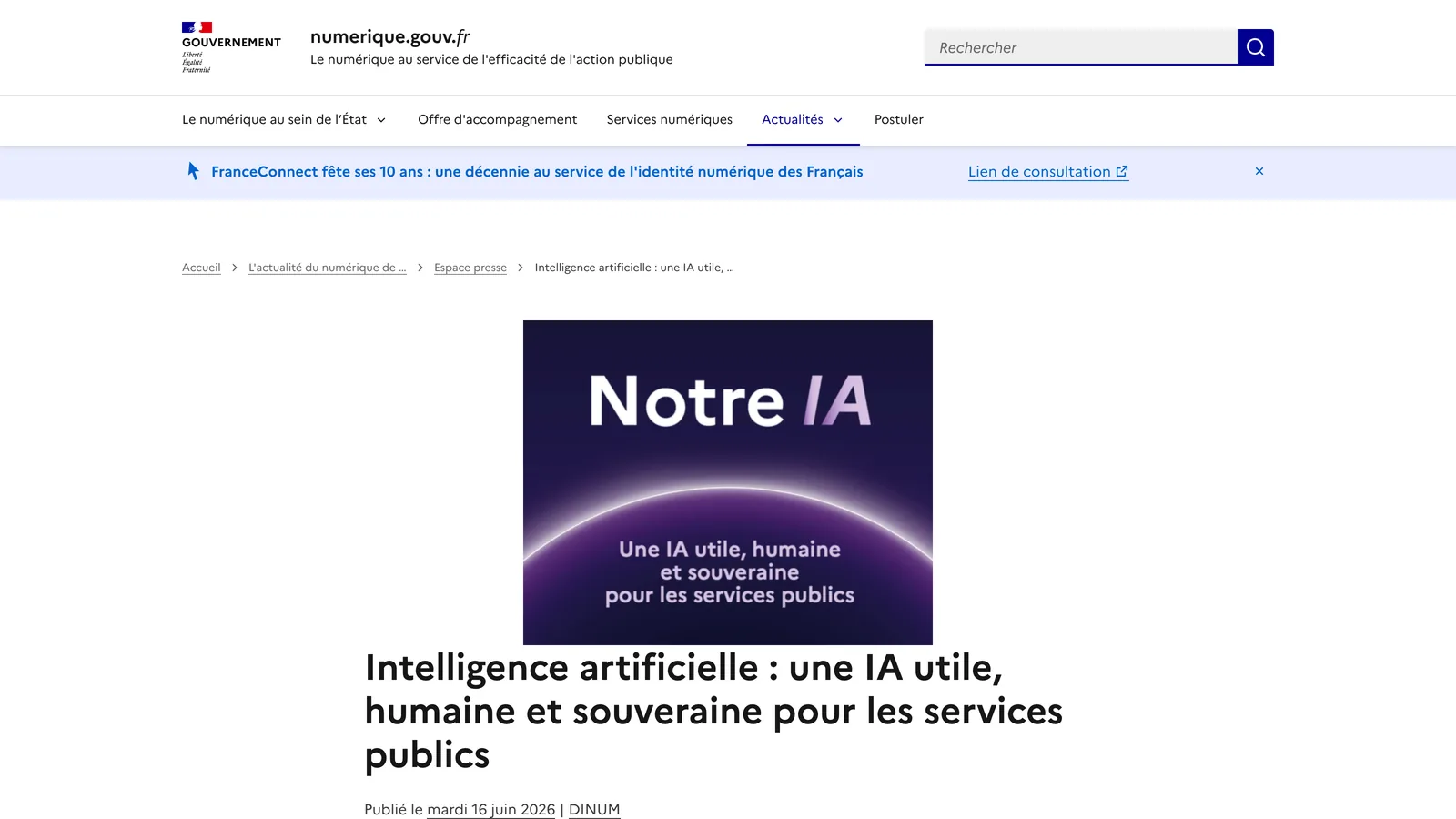
- The State's "L'Assistant". On 16 June 2026, DINUM announced the rollout to all State employees of this assistant built with Mistral AI and hosted by Outscale on SecNumCloud, after a 10-month test with 10,000 staff. The press release reports time savings of up to 16% on document summaries.
- Ministry of the Armed Forces. A framework agreement was notified to Mistral AI on 16 December 2025 and announced on 8 January 2026. It covers all the armed forces plus CEA, ONERA and SHOM, and is run by AMIAD.
Other French hosts are listed by ANSSI as undergoing qualification. We name no qualification we could not read on an official source: if your tender requires SecNumCloud, ask for the qualification certificate of the exact offer.
Beyond chat
Agents, connectors and MCP
| Feature | Claude | ChatGPT (per OpenAI's help centre) | Mistral Vibe |
|---|---|---|---|
| Connectors | One MCP connector directory shared by Claude.ai, Desktop, mobile, Claude Code and Cowork; admin approval on Team | Apps and full MCP support on Business and Enterprise (web), with admin control over actions | 100+ tools (email, calendar, Slack, GitHub, Jira), full MCP compatibility |
| Agents | Claude Managed Agents: $0.08 per session-hour plus tokens | Agent mode on Plus, Pro, Business, Enterprise and Edu; off by default on Enterprise | Async coding agents that open pull requests |
| Custom connectors | Custom remote MCP connectors on all plans | Developer mode on Business and Enterprise | Mistral Forge for fine-tuning |
All three providers have adopted MCP, the protocol that connects an assistant to your tools. An MCP connector written for your CRM or document system can therefore work with several assistants, which limits lock-in. How the protocol works is covered in our article on MCP and Claude for businesses.
On ChatGPT Enterprise, an admin has to enable agent mode per role. On Claude Team, the admin approves connector requests. In both cases, decide before rollout which tools an agent may change and which it may only read.
Decision
Decision grid by situation
| Your situation | Starting point | Check before signing |
|---|---|---|
| Sensitive health, legal or HR data | Mistral Vibe Enterprise, or Claude through Bedrock or Vertex in an EU region | Training opt-out, region actually configured, signed DPA |
| Microsoft 365 company | Claude Team (Microsoft 365 connection listed on its pricing page) or ChatGPT Business | US storage at Anthropic; no EU residency on ChatGPT Business |
| Development team and coding agents | Claude Team (includes Claude Code) or Mistral Vibe Pro/Team (coding in the CLI, IDE or web) | Real usage per developer, agent permissions on repositories |
| Public administration or public tender | Mistral on SecNumCloud hosting (the model chosen by the French State) | SecNumCloud certificate for the exact offer |
| Small budget, 2 to 5 people | Claude Team or ChatGPT Business at $20 billed annually; Mistral Vibe Team at $24.99 excl. tax monthly | Tax basis and annual commitment |
| High-volume business application | API: Mistral Large 3 or Small 4, Claude Haiku 4.5, GPT-5.6 Luna for sorting; top-tier models for analysis | Cost measured on a real sample, tokenizer included |
For a law firm, professional secrecy adds to the storage question; our AI for legal teams guide covers the possible uses. If the decision affects the whole company, AI consulting helps scope the data involved before choosing a provider.
About
Who wrote this comparison
Lumyniq is an AI automation agency based in Paris. It integrates Claude and Mistral through their APIs into custom AI agents and workflows connected to its clients' tools, with an audit of the process before any quote. Details of Anthropic integrations are on our Claude integration page.
FAQ